Custom post types, not pages
Services, areas, sub-services, symptoms, brands and appliance types are each their own post type in ACF, so the site composes pages from records instead of storing hundreds of copies.
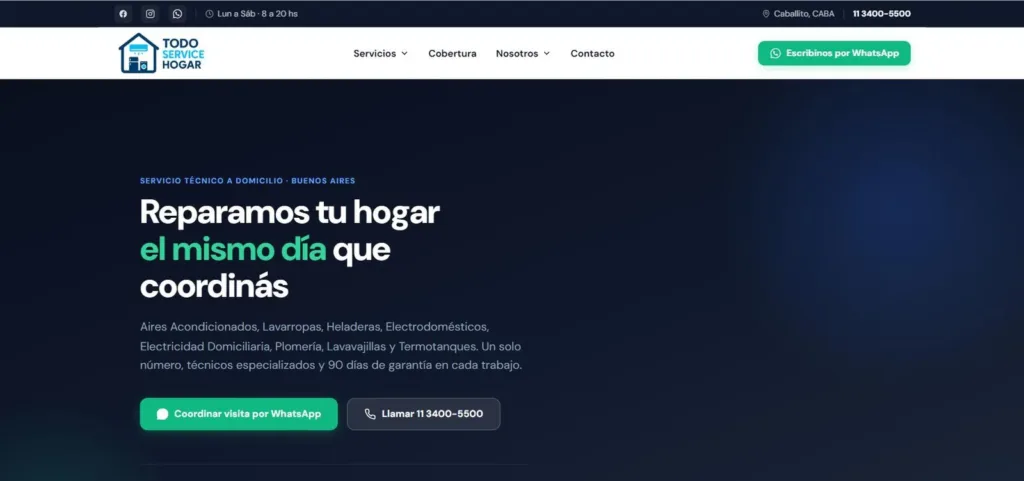
Todo Service Hogar repairs air conditioning, fridges, washing machines and more across Buenos Aires. We built the site as a content system rather than a set of pages: eight services multiplied across fifty-nine areas, driven by custom post types, so one piece of writing reaches every neighbourhood it applies to.
Todo Service Hogar is an at-home technical service business in Buenos Aires, covering air conditioning, fridges, washing machines, dishwashers, water heaters, small appliances, domestic electrics and plumbing. Their customers search at the moment something breaks, from a phone, with a neighbourhood in mind, which makes local search the whole game.
Industry: Home repair and technical services
Eight services across fifty-nine areas of Buenos Aires is nearly five hundred distinct things a customer might search for, and every one of them is a different page in Google’s eyes. Writing them by hand was never realistic. Generating them naively was worse: a few hundred near-identical pages is not a local SEO strategy, it is a duplicate-content problem that takes the whole domain down with it.
We designed the site as a content system rather than a pile of pages. Everything that repeats lives in one place; everything specific to a service, an area, a symptom or a brand is a record an editor can write once.
Services, areas, sub-services, symptoms, brands and appliance types are each their own post type in ACF, so the site composes pages from records instead of storing hundreds of copies.
Each area carries its own copy, naming its avenues, its building stock and the faults that actually turn up there, the part that makes a local page worth ranking rather than a duplicate.
Symptom pages, brand coverage and 93 FAQs give the structure that answer engines read, which is why the site now shows up inside AI assistants as well as in the results page.
Eight services, 59 areas, 50 sub-services, 87 symptoms, 72 brands and 55 appliance types, each a custom post type. Pages are composed from these records, so a change lands everywhere it belongs at once.
Each area gets its own paragraph and its own list of common faults, written for that area rather than templated across all of them.
Yoast for titles, meta and schema; clean URLs carrying the service and the area; internal linking between neighbouring areas so the set is worth more than the sum of its pages.
93 FAQs, symptom-level pages and structured data aimed at how answer engines read a site, not only how a search index crawls it.
LiteSpeed caching, and WhatsApp as the primary call to action on every page, because that is how this audience actually gets in touch.
The site went live in September 2025. Twelve months of Search Console data show a domain that started from nothing and is now visible across the whole of its market, with the long tail doing exactly what the architecture was built to do.
Todo Service Hogar is the case that shows what local SEO looks like when it is treated as an architecture problem instead of a page-count problem. The multiplication of services by areas only works if every resulting page has something of its own to say, so the system was built to make that writing cheap to produce and impossible to skip. A year in, the site ranks for over a thousand queries it did not exist for, and answer engines quote it by name.